GHK-Cu
GHK-Cu research peptide. Third-party Certificates of Analysis are published for tested products and batches. Fast UK dispatch. For laboratory research use only.
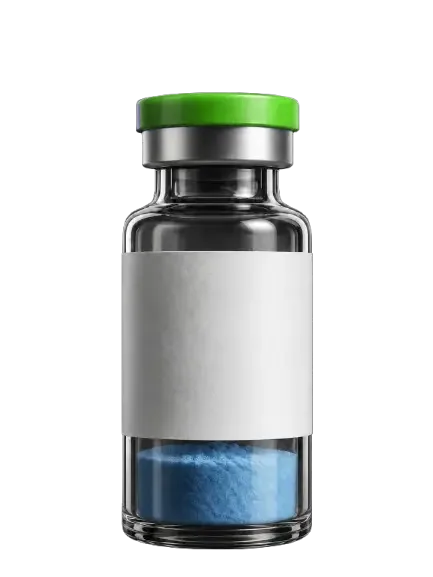
GHK-Cu research peptide. Third-party Certificates of Analysis are published for tested products and batches. Fast UK dispatch. For laboratory research use only.
Available sizes: 50 mg, 100 mg
GHK-Cu (Copper Tripeptide-1) is a naturally occurring copper-binding peptide first identified in human plasma. Interest in GHK-Cu has expanded significantly in regenerative and dermatological research as scientists explore its interaction with collagen signalling pathways, connective tissue organisation, and skin structure regulation.
The peptide forms a complex with copper ions, creating the characteristic blue copper-peptide structure frequently studied in models examining tissue remodelling, extracellular matrix signalling, and age-related changes in skin integrity.
Because copper plays an essential role in enzymatic processes linked to connective tissue stability, GHK-Cu has become one of the most widely referenced peptides in studies exploring dermal resilience and structural protein signalling.
Collagen Signalling Pathways: GHK-Cu is associated with pathways involved in collagen organisation and extracellular matrix structure.
Dermal Structure Research: Frequently examined in studies exploring skin density, elasticity pathways, and connective tissue signalling.
Copper Transport Mechanism: The peptide functions as a carrier for bioavailable copper ions involved in enzymatic tissue processes.
Tissue Remodelling Models: Researchers often study GHK-Cu in signalling pathways related to cellular turnover and structural protein regulation.
GHK-Cu has been investigated for its interaction with pathways involved in collagen synthesis, extracellular matrix signalling, and gene expression regulation. These mechanisms are closely associated with connective tissue organisation and dermal structural stability.
Researchers also examine how the copper-peptide complex influences enzymatic systems involved in tissue signalling, as copper ions play key roles in several biological processes related to connective tissue integrity.
Dermal structure and skin signalling studies
Collagen and extracellular matrix pathway research
Tissue remodelling and regenerative signalling models
Age-related changes in connective tissue structure
GHK-Cu is frequently referenced alongside BPC-157 and TB-500 in regenerative research protocols.
This three-peptide combination forms the basis of the GLOW blend, where collagen signalling, vascular response pathways, and cellular migration mechanisms are explored together in coordinated regenerative models.
Certificates of Analysis are published for tested products and batches. A certificate is a batch-specific record: it reports what was measured, by which method, on a stated date, against a batch identifier. It is evidence about the sample analysed at the time of analysis, and it is silent on attributes it does not list and on what has happened to the material since.
The batch number is the field that connects the document to a physical vial. Where the identifier on a vial does not appear on a certificate, the certificate does not describe that vial, however thorough the analysis behind it was. Batch records can be searched directly, and the guides below explain what each field establishes and what it does not.
Supplied for laboratory research use only. Not for human or veterinary use.